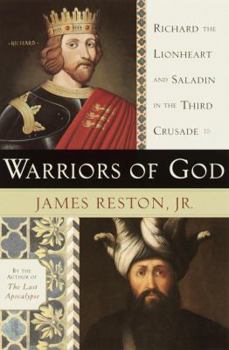
I have endless respect for nonfiction writers, especially those who manage to bring history to life with the vividness and immediacy of a good novel, all while sticking to the facts. In Warriors of God, James Reston, Jr. does exactly that.
It’s a popular history of the Third Crusade (the one that, until now, I knew the least about), told through the framework of a clash of personalities between Saladin and Richard the Lionheart. Whether you’re writing fiction or history, the rule for making readers invested is the same: you start with character, continue with character, and end with character. Make the people interesting, the stakes personal. Seed the plot with emotion, specific or implied, not just movement. You show why it all matters.
James Reston, Jr. has both terrific research chops and impeccable narrative instinct. Which is this book’s greatest strength, but also, possibly, its greatest flaw.
In delving so deeply into his characters’ psyches, he always chooses the most interesting interpretation of their motives. In his view, Richard I and Philip Augustus of France weren’t simply squabbling over power and territory in Normandy; they were former paramours whose love had turned to loathing. Never mind that much of the evidence for Richard’s homosexuality was circumstantial, and, while I’m no historian, I believe that most historians these days doubt that the Lionheart was gay.
To be fair to James Reston, Jr., this book came out in 2001, when the consensus was different. Anyway, I should move on before—
Actually, you know what? This is too interesting not to take a brief detour.
One of the most commonly cited pieces of “evidence” for Richard’s homosexuality is a quote attributed to Gerald, the Archdeacon of Wales (and if anyone knows the signs of homosexuality, it’s surely a Catholic clergyman!):
“[Richard] so honored Philip that by day they ate at one table, off one dish, and at night they slept in one bed. And the King of France loved him as his own soul.”
To a modern ear, this sounds exactly like Medieval euphemism. But that’s anachronistic. Truth is, castles only had a small number of beds, typically reserved for the most prominent personages, so it was common for great men staying under one roof to share the sheets. As for the special closeness of their relationship, there was likely an intentional effort to make them get along in their youth in hopes that these two future leaders wouldn’t go to war when they were older (a scheme that failed miserably).
I’m far from an expert in any of this, and I agree it would be far more interesting if one of history’s greatest warriors was gay (don’t come for me, internet). But that’s my understanding of the general historical consensus.
Anyway, moving on . . .
I know far more about the Second Crusade than the Third. In fact, I recently read another excellent history, God’s Wolf, by Jeffrey Lee, that tells the life’s story of Reynald de Châtillon, the most infamous and bloodthirsty crusader of them all. Because I’m more familiar with the Second Crusade, I knew enough to take issue with quite a few of Reston, Jr.’s characterizations and interpretations. For example, he takes Châtillon at face value: a thug, a bloodthirsty war hawk, brainlessly addicted to violence at any cost. Châtillon was a hawk, to be sure, and was certainly bloodthirsty. But brainless? Reston, Jr. assumes no deeper motivation than the love of butchery for Châtillon’s provocative raids upon Muslim pilgrimage routes. But truth is, Reynald’s raids were likely a calculated attempt to weaken Saladin’s standing among his coalition by painting him as unable to protect other Muslims, undermining Saladin’s goal of uniting Egypt and Syria, which, if successful, would surely spell the end of Outremer.
I could say more about this, or list other examples, but the point is, Reston, Jr. misses some complexity and depth by wanting to have protagonists and antagonists. It’s a decent narrative impulse, but subpar scholarship.
But the biggest problem, in my opinion, is not that Reston, Jr. assumes motivations, but that he expresses such confidence about them, as though there’s no alternative view. He doesn’t say, “This is what I think about Reynald de Châtillon’s motives, but here are some other theories.” He doesn’t tell us that most historians disagree about Richard I’s sexual proclivities (though, again, he was writing in 2001).
And since I disagree with the stuff he says about a subject I know something about, how am I supposed to trust him when he talks about the Third Crusade, for which I’m using this book as my introduction?
All this may make it sound like I don’t respect James Reston, Jr., as a writer. Nothing could be less true. As I said, he has terrific skill at research and an astonishing eye for detail. The main reason I read history, besides the sheer love of it, is to lend texture to my own writing and discover those quirky little anecdotes you can’t make up on your own. The fantasy duology I’m currently writing is heavily inspired by the history of the Crusades, and I intend to unabashedly cannibalize lots of the details and stories that Warriors of God has made me aware of. So I owe him a debt of gratitude.
Please note: I said cannibalize, not plagiarize. Looking at you, AI.

